Create a New Entitlement Role
If This is Your First Time Creating New Roles:
We recommend taking a quick moment to consider the following before you begin creating new roles:
-
 What is your strategy?
When first starting out, we recommend starting very broadly. For example, many clients will start by creating roles that will capture the largest number of employees such as Loan Officers or Tellers, and then - over time - gradually work toward roles that are more specific such as "Remote Access" or "Teller Supervisors", and so on.
NOTE: Entitlement Roles are critical if you are using the Operations module within Permission Assist; they'll be used to determine which applications and permissions people are given if they are hired, if they transition to a new role, and so on. We recommend planning to spend a little more time up front to ensure your roles are set up to the level of granularity that will make these processes accurate and efficient.
-
After your Entitlement Roles are set up, what is your maintenance process?
Change happens - you might replace outdated systems, vendors may introduce new modules and permissions to existing applications, job responsibilities may evolve, or you may add new applications into Permission Assist. Deciding how often you want to update entitlement roles and who will be maintaining the role can help to streamline the process.
To create a new Entitlement Role, complete the following steps:
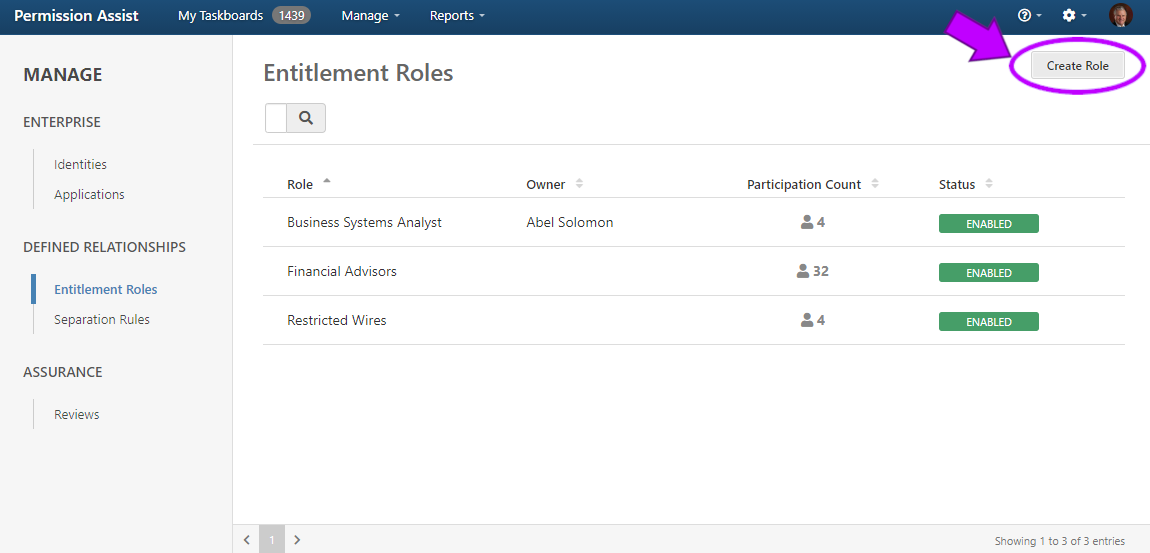
From the Entitlement Roles list, select the Create Role button near the top right corner of the page (see example below).
The Creating an Entitlement Role page is displayed and Permission Assist walks you through a series of questions to help you create the role. Refer to the sections below for more information about each step.
Name
|
Question/Option |
Description |
|---|---|
| Enter a short, easily understood, display name. |
Allows you to enter a short name for the Entitlement Role. After entering a name, select the Continue button to proceed to the next step, "Describe". |
Describe
|
Question/Option |
Description |
|---|---|
| Briefly explain what access the role provides. |
This area allows you to enter a longer more descriptive explanation of what the entitlement role is, who it includes, or the access it defines. After entering a description, select the Continue button to proceed to the next step, "Owner". |
Owner
|
Question/Option |
Description |
|---|---|
| Who will be managing this role? |
Within Permission Assist, an Entitlement Role Owner may not always be the one making decisions about every application within the role, but they are the person ultimately responsible for making sure the Entitlement Role is set up and properly managed. For example, the owner may have application owners or a "role committee" decide which permissions are allowed or denied for each application. In these cases, the Entitlement Role Owner would still oversee the process and make sure the roles are properly defined, committed, and enabled within Permission Assist. Select this field and pick an owner from the list. After picking the owner, select the Continue button to proceed to the next step, "Enrollment". |
Enrollment
|
Question/Option |
Description |
||||||||
|---|---|---|---|---|---|---|---|---|---|
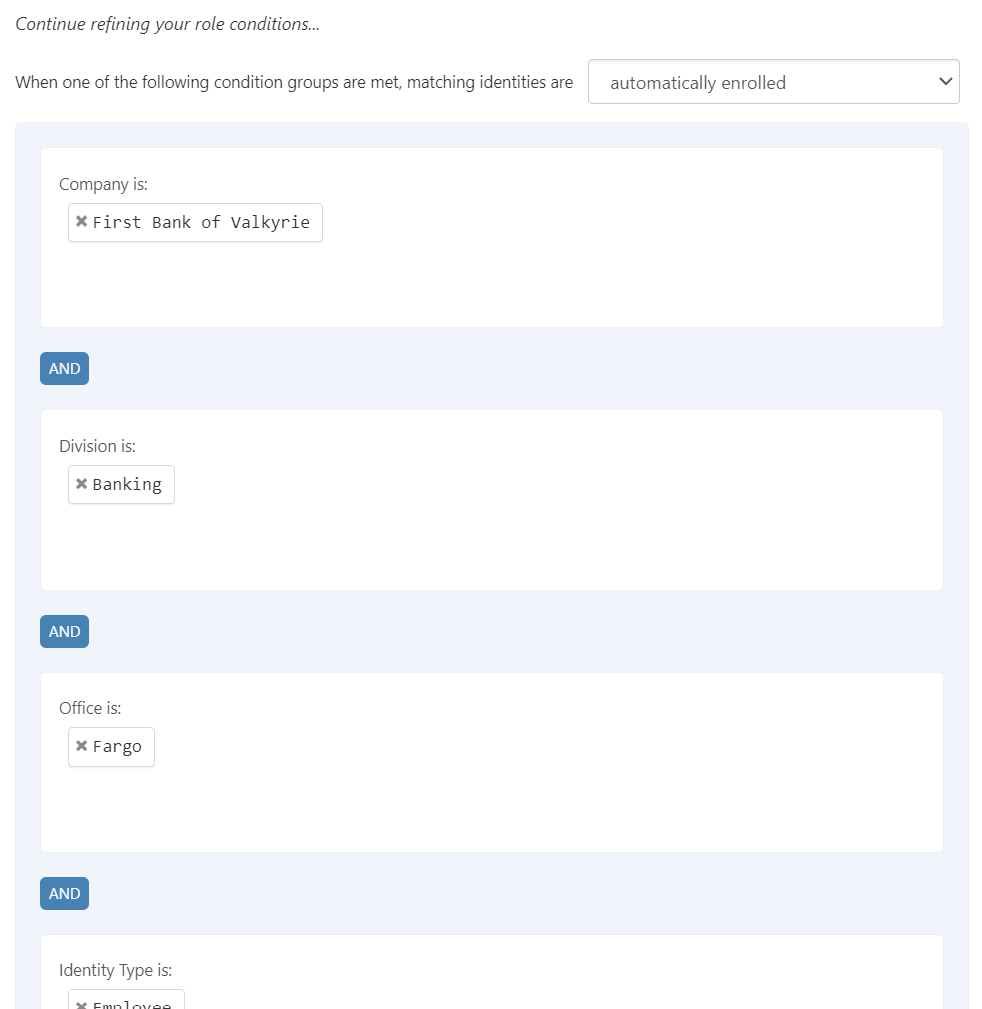
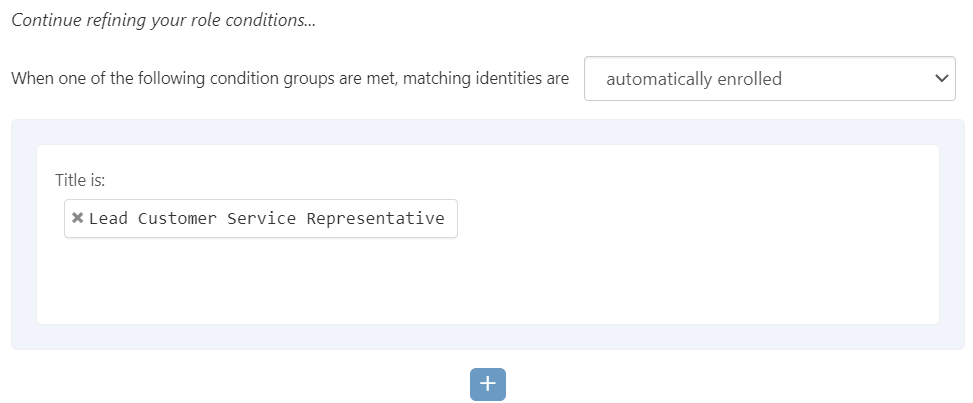
| Define the conditions that an identity must match to be part of this role. |
This area allows you to determine how the conditions will be defined. Select one of the following options:
|
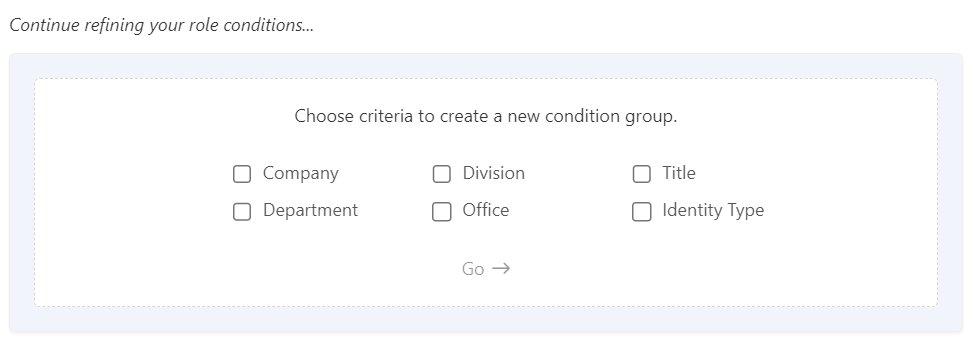
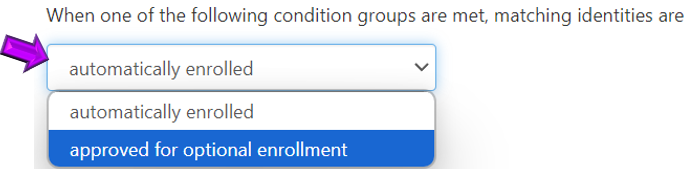
 . A new criteria area is displayed (see picture below).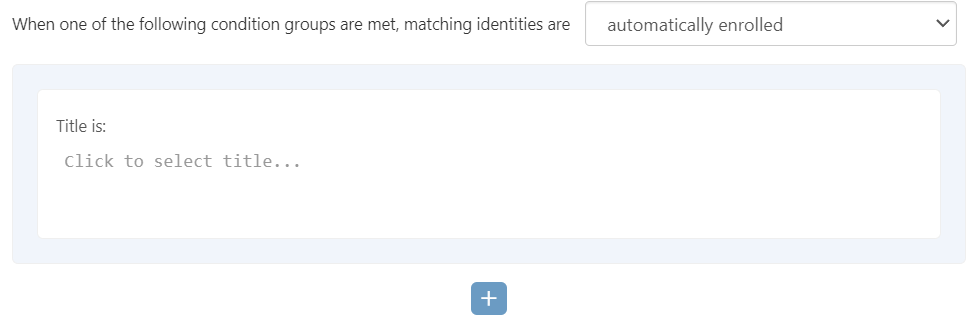

Recommend
|
Question/Option |
Description |
||||||
|---|---|---|---|---|---|---|---|
| Do you want Permission Assist to automatically recommend ideal access? |
Select one of the following options:
After making a selection, select the Continue button to proceed to the next step, "Submit". |
Submit
When all steps have been completed, select the Submit button on the right side of the page to create the new role based on the information entered.
After the role is created, you can add applications, allow or deny privileges, change settings, or manually enroll people to the role if needed.
When the role is ready to be used for personnel events and within reviews, enable it.